Beta · capped at 1,000 Strava athletes

Run smarter. Walk smarter.
Score every activity.

Rundown turns every Strava run and walk into a 0–100 score — with the metrics behind it tuned to what you actually did. A run is graded on pace, zones, and fade; a walk on zone-2, cadence, climb, and load. One number. Honest comparisons.

Welcome back — you're #— on the list. We'll be in touch.
Which build?
We email once. No spam, ever.
You're on the list
0
Your position We'll email when your seat opens up.

Tip: each invited friend who joins from your link bumps you up the queue.

The problem

You ran. Now what?

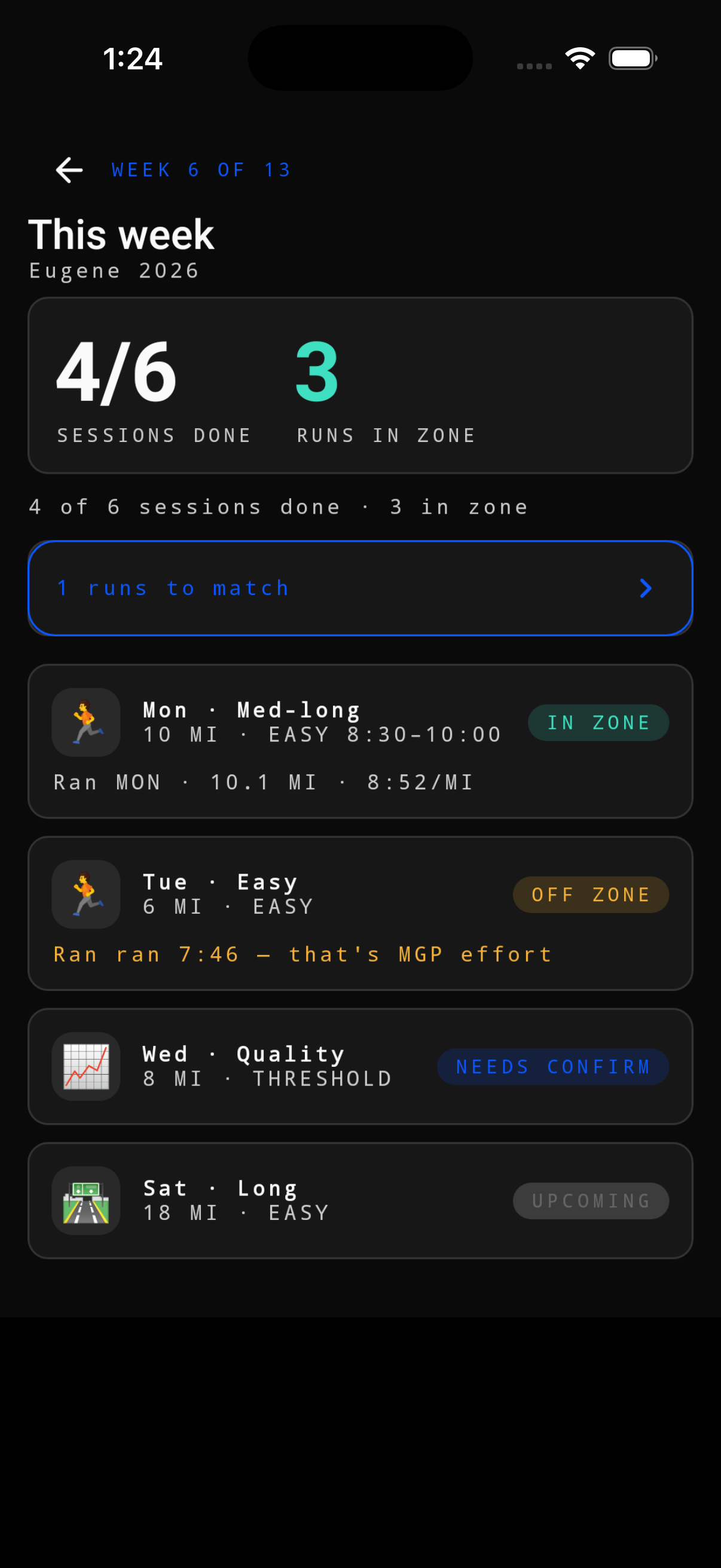
Pace, heart rate, splits — your watch hands you 40 numbers and walks away. Was that run good? Did it move you closer to your goal? Are you over-training? Most runners shrug and load the next one.

Today

  • Look at the kudos count.
  • Eyeball pace vs. last Tuesday.
  • Wonder if Z3 was the right call.
  • Move on. Repeat next run.

With Rundown

  • One score, 0–100, in plain English.
  • The two things you nailed.
  • The one thing to fix next time.
  • Trend across weeks, not vibes.
The Rundown Score

Every activity is different. The score is too.

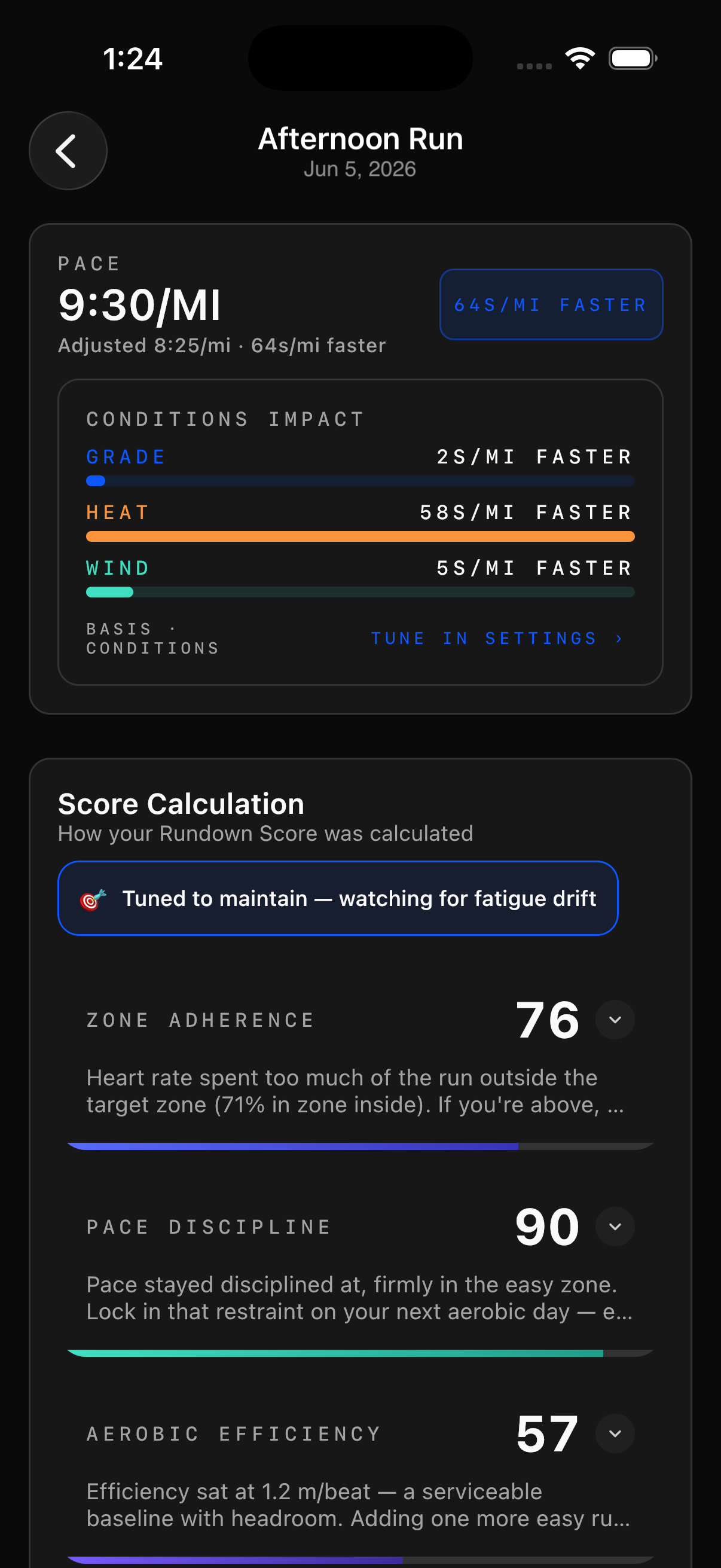
A 4×400 rep workout, a Sunday long run, and a weighted ruck aren't graded the same way — so Rundown swaps the metrics it scores based on what you actually did. One number out of 100. The metrics behind it change to match the session.

An easy run is about restraint.

If your heart rate stayed in Zone 1–2 and your pace didn't creep up, you ran easy. If it didn't, you didn't.

  • Zone Adherence Primary signal

    How much of the run sat inside the easy-zone HR target — and how far above when you drifted.

    % in target zone % above target Avg HR
  • HR Drift

    Late-run heart-rate creep at the same pace — the giveaway that an "easy" run was actually a tempo.

    Overall drift % First half HR Second half HR
  • Pace Discipline

    Steady pace, no surges. Variability matters more than absolute speed here.

    Avg pace Speed CV Zone fit

A tempo lives in the discomfort zone.

You're trying to spend a long time at threshold — Zone 4 — without falling out the top of it. Did you hold it, or did it hold you?

  • Tempo Sustain Primary signal

    Time spent at or above your tempo threshold, and whether HR stayed steady or spiked.

    % at Zone 4+ Avg HR Peak HR
  • HR Drift

    The whole point of a tempo is metabolic. If HR drifts 6–8 bpm at the same pace, the effort wasn't sustainable.

    First half HR Second half HR Drift %
  • Pace Discipline

    Held the prescribed pace band without bursts.

    Avg pace Speed CV

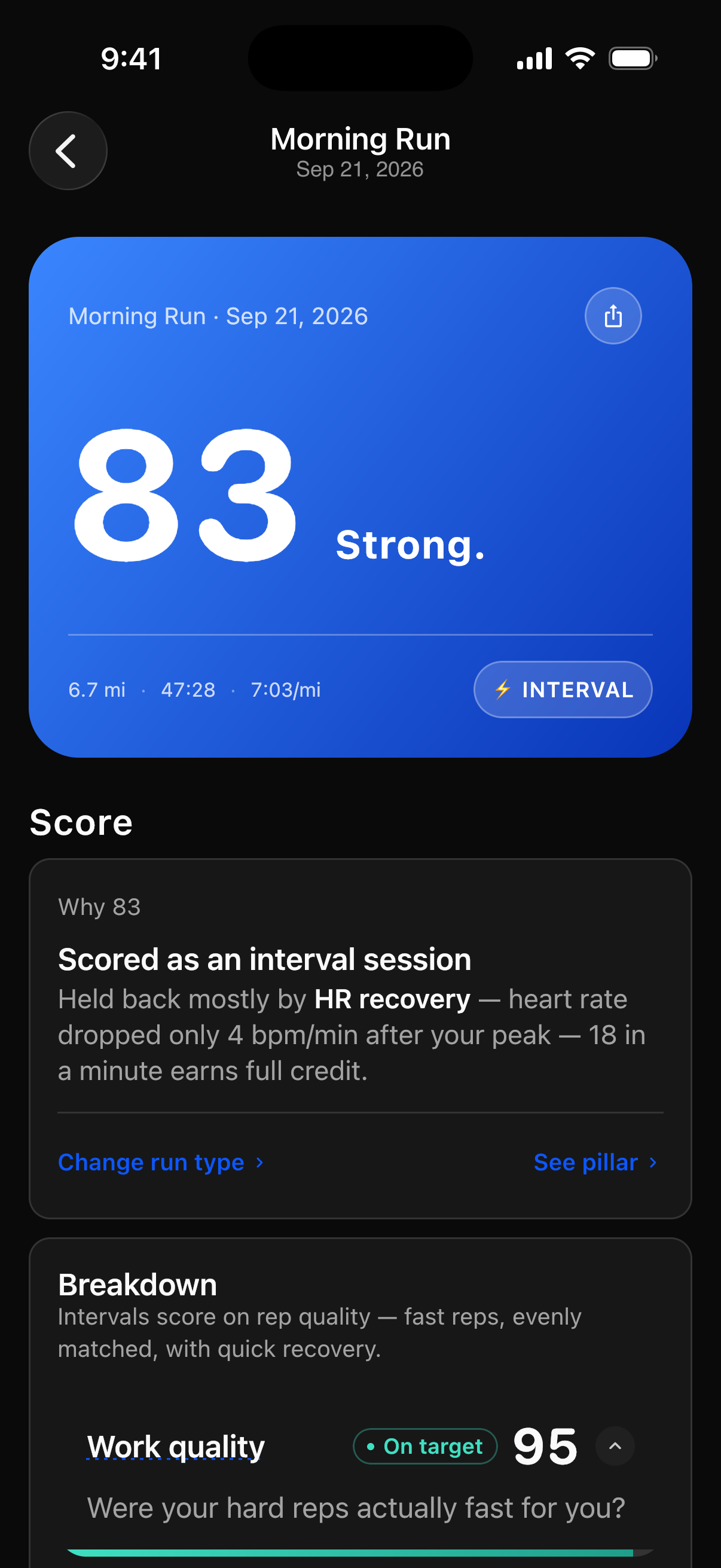
Intervals are graded rep-by-rep.

Anyone can crush rep one. The scoring asks whether rep six looks like rep one — and whether you actually recovered between them.

  • Work Quality Primary signal

    How fast and clean the working reps were — bursty starts cost you here.

    Work pace Burst count Work-phase CV
  • Interval Consistency

    Rep-to-rep variance. A 1:32 / 1:34 / 1:31 / 1:48 set is not the same workout.

    Rep count Rep CV Avg work speed
  • HR Recovery

    How fast your HR fell between reps. Faster recovery, fitter engine.

    Drop rate (bpm/min) Peak HR Final HR

The long run is judged at minute 90.

Everyone holds pace for the first 5K. Whether the last quarter looks like the first is the whole game.

  • Fueling Signal Primary signal

    Pace fade between the first and last quarter of the run. A clean long run holds within 3–4%.

    Q1 vs Q4 fade Q1 pace Q4 pace
  • Aerobic Efficiency

    Meters per heartbeat. Cardiac drift hides here — same pace, climbing HR, falling efficiency.

    m / beat Avg HR Total beats
  • HR Drift

    How much your engine fought you in the back half. Big drift on a long run = under-fueled or under-trained.

    First half HR Second half HR

Race day has one job: execute.

The plan was the plan. Heat, hills, and pacing get accounted for — but the score is mostly about whether you ran the race you said you'd run.

  • Pace Execution Primary signal

    How close you ran to your target race pace — with credit for negative splits, penalty for a positive split.

    Avg pace Session fit Speed CV
  • Zone Adherence

    Distance-appropriate effort zones. A 5K should live above threshold; a marathon shouldn't.

    % in target zone Avg HR
  • Conditions Adjustment

    Heat, humidity, dew point, elevation gain. Credit where the day was working against you.

    Temperature Dew point Elevation gain

Recovery has the opposite job.

Going slow is the workout. The score rewards low intensity and punishes the urge to "just push it a bit."

  • Recovery Intensity Primary signal

    How much of the run sat below the easy threshold. Cross above it for more than a minute and the score drops.

    % easy Max HR Threshold
  • Zone Adherence

    Time in Zone 1. There's no upper-zone work on a recovery day.

    % in Zone 1 Avg HR

Every run also gets credit for Consistency Streak (your hard/easy ratio across the past 14 days) and Conditions Adjustment (heat & humidity). The session-specific metrics above are what move the needle most.

Walks are scored on what makes a walk count.

Rundown auto-detects whether you walked casually, briskly, climbed, or carried weight — and grades all of them on the same five pillars. Long enough, in zone 2, with steady cadence, real climbing, and meaningful load wins the day.

Casual Brisk Incline Hike Ruck Weighted
  • Zone 2 Adherence Primary signal

    Share of moving time in HR zone 2 — the aerobic-base sweet spot for walking. Wander up into Z3 and the score nudges down.

    % in Z2 Avg HR Time above Z2
  • Cadence Quality

    How steady your step cadence held against your typical walking rhythm. Stride consistency is the difference between a walk and a stroll-with-stops.

    Avg cadence Cadence CV Personal baseline
  • Elevation Gain

    Vertical metres climbed per kilometre — uphill load earned by this walk. Climbing turns a flat stroll into real aerobic work.

    Total gain m / km Avg grade
  • Load Stimulus

    Cumulative weekly load (pack or vest weight × minutes) toward your stimulus target. Carrying weight under zone 2 builds durability without the breakdown cost of running.

    Load (lb) Load · min Weekly target
  • Duration

    Total walk time relative to your daily zone-2 minute goal. Short and sweet still counts — but minutes in zone are the cardio currency.

    Total minutes % of daily goal

Walks use one scoring model across all six walk types. The auto-detected type doesn't change what is measured — it changes how Rundown talks to you about the result.

Weekly insights

The "why" behind every number.

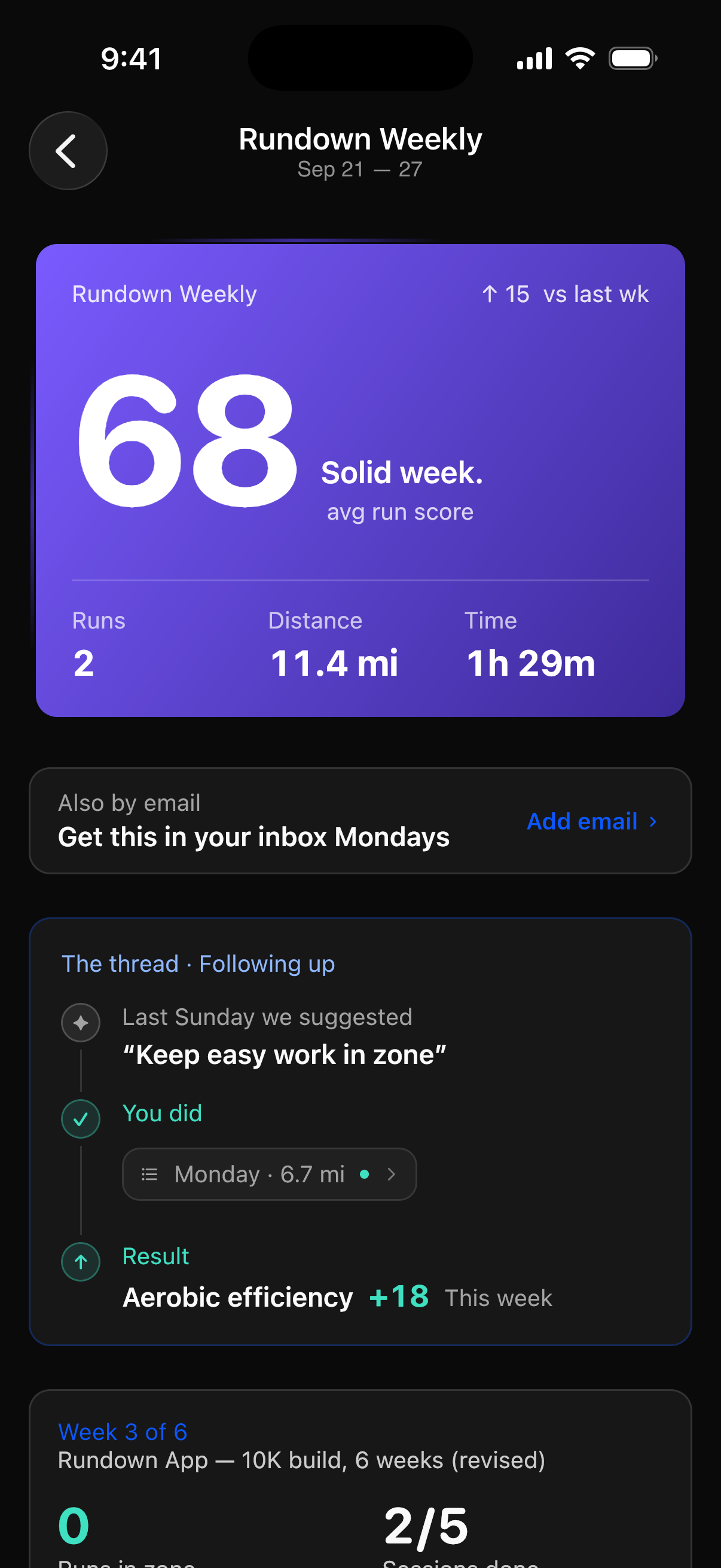
Every Monday Rundown reads your week — runs and walks both — and tells you what actually moved the needle. No dashboards to interpret.

Aerobic efficiency improved. Same pace, average HR dropped 4 bpm this week.
+6.4
Heavier rucks, same HR. You carried 28 lb on 3 walks this week — load stimulus +42% with no extra cardiac cost.
+4.2
Consistency slipped on long runs. Last 3 km were 18s/km slower than km 4–10. Even it out.
−3.1
You handle heat better than 78% of users. Adjusted pace held under 1.2% slowdown at 28 °C.
+1.8
Privacy

Your data is yours. Period.

Rundown reads your Strava activities to score them — nothing else. We don't sell anything to anyone, and you can pull the plug in one tap.

Activities only.

We pull the activities you authorize — runs, walks, hikes, splits, heart rate, weather. No DMs, no social graph, no friends list.

Encrypted, on you-controlled keys.

Tokens stored encrypted at rest. Revoke access from your Strava settings or in-app in one tap.

Delete in one tap.

Export your scores as JSON. Delete your account and everything we hold — no email forms, no waiting.

Beta access

Why only 1,000?

Strava caps API calls until an app is verified. To keep scores fresh for everyone in beta, we're holding the door at 1,000 athletes. Earn a spot, help us pressure-test the scoring model on runs and walks, and you'll keep beta pricing forever.

473 on the list of 1,000 cap
  1. 1
    Join the waitlist Drop your email. Takes 8 seconds.
  2. 2
    Get the invite We open ~50 seats per week. You'll get an email with a one-tap link.
  3. 3
    Connect Strava → score your back catalog Rundown scores your last 90 days the moment you connect.
  4. 4
    Help shape v1 Direct line to the team. Your weekly feedback ships into the product.